

Jewish Bride, Constantinople
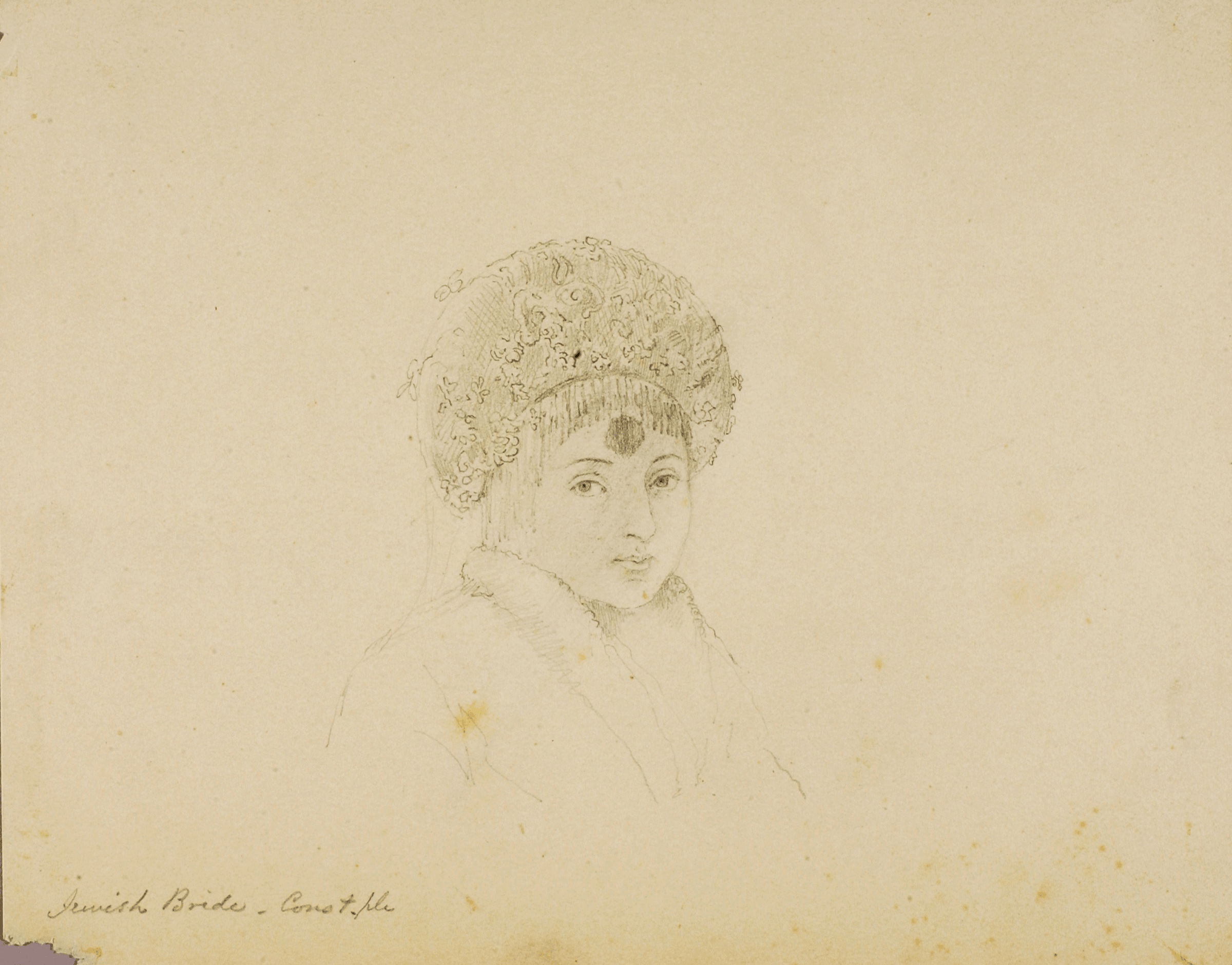
Created by Miner Kilbourne Kellogg, born Manlius Square, NY 1814-died Toledo, OH 1889. Medium: Pencil on Paper. Located in the Smithsonian American Art Museum.
Jewish Welfare Board Postcard
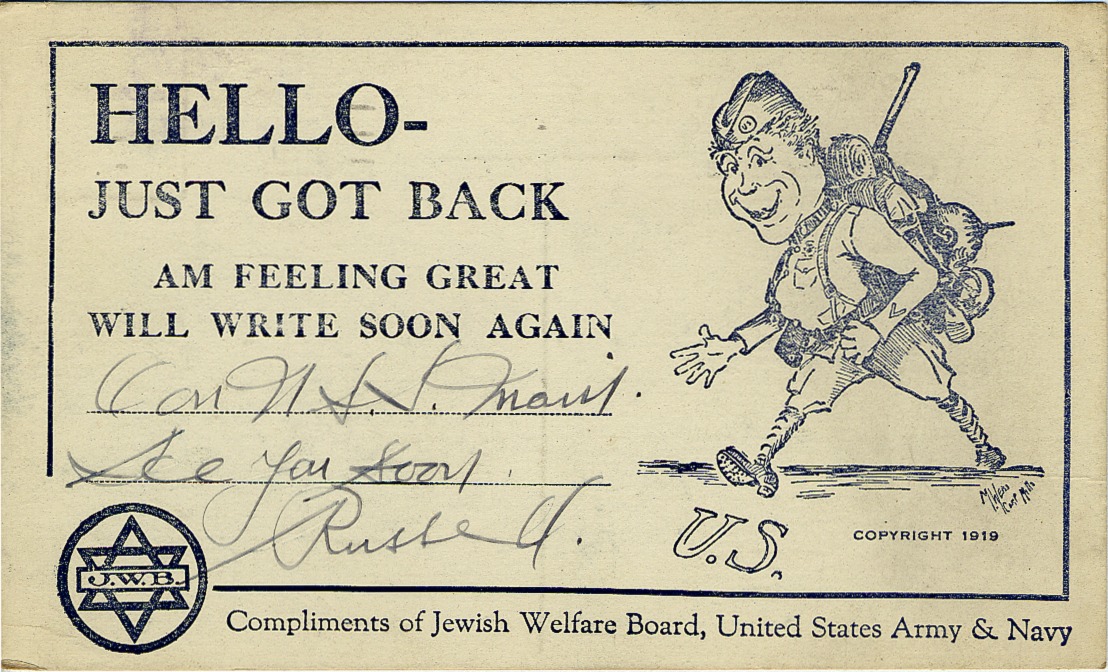
World War I Jewish Welfare Board postcard, showing a drawing of a US soldier. Addressed to Mr. Nathan Worman, 914 N. 66th Street, West Philadelphia, Pennsylvania. Medium: Paper, ink. Located in the National Postal Museum.
Jewish Welfare Board Postcard
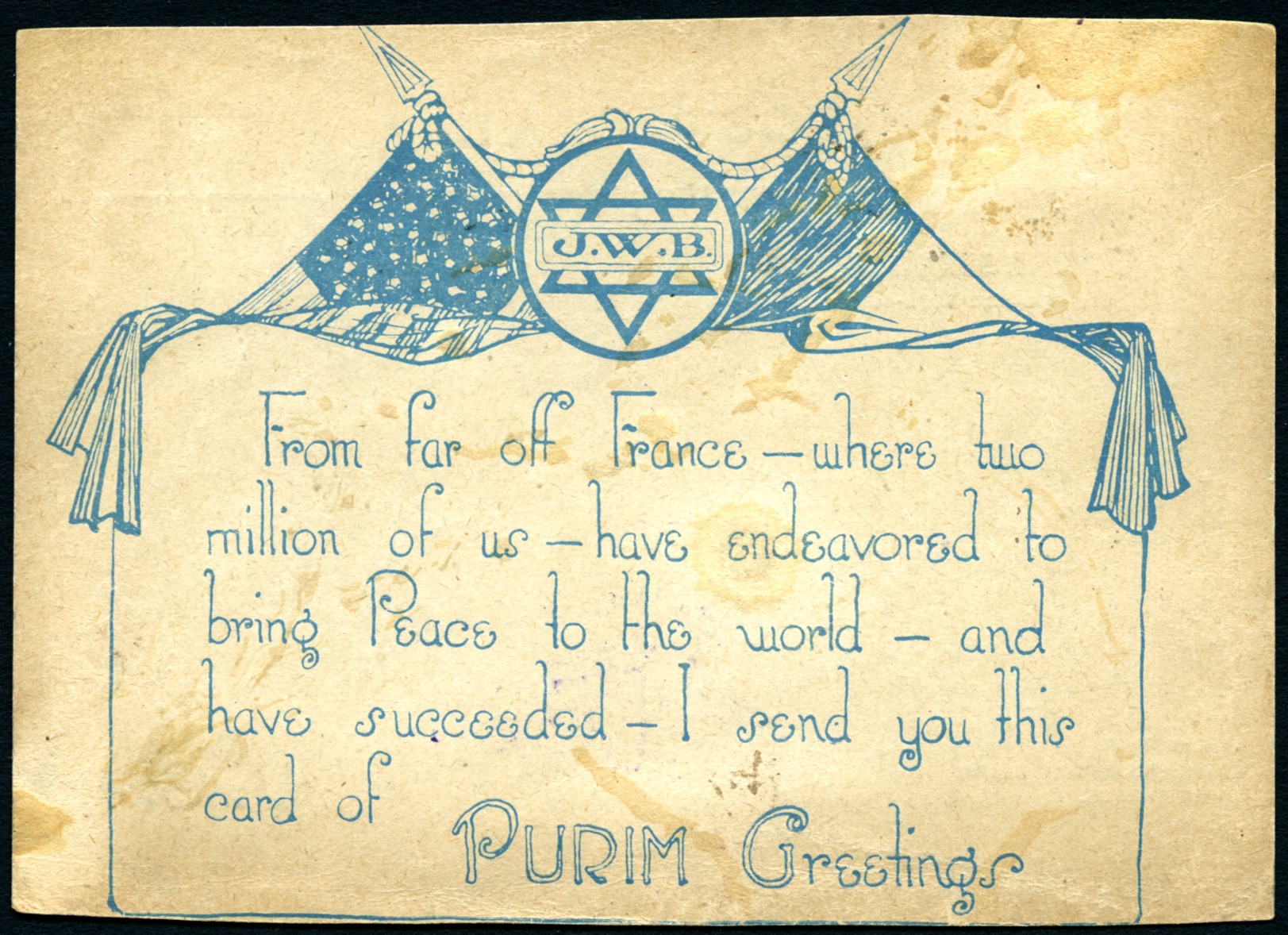
This postcard was sent home to America by a serviceman deployed to France during World War I. The preprinted message on this postcard provided by the Jewish Welfare League wishes the recipient Purim greetings, marking a Jewish holiday. It also outlines that the sender is in France fighting for peace and shows an American and French flag tied together behind a Star of David.
During World War I pre-printed stationery was issued free of charge by the Jewish Welfare Board to serviceman stationed abroad. Other non-profit organizations did likewise, including the American Red Cross, the YMCA, the Knights of Columbus and the Salvation Army. The idea was to reassure families in the United States of the wellbeing of servicemen and to encourage the servicemen to communicate regularly with their families. The military supported this initiative as it was widely believed to increase morale. Like other military mail, messages written on this charitable stationery could be mailed free of charge and were subject to censorship. Date: 1919. Medium: Paper, ink. Located in the National Postal Museum.
References
Sanford, Hennen M. The Mail of the A.E.F. American Expeditionary Forces. The American Philatelic Society, Maryland, 1940.
Ephraim Bonus, Jewish Physician
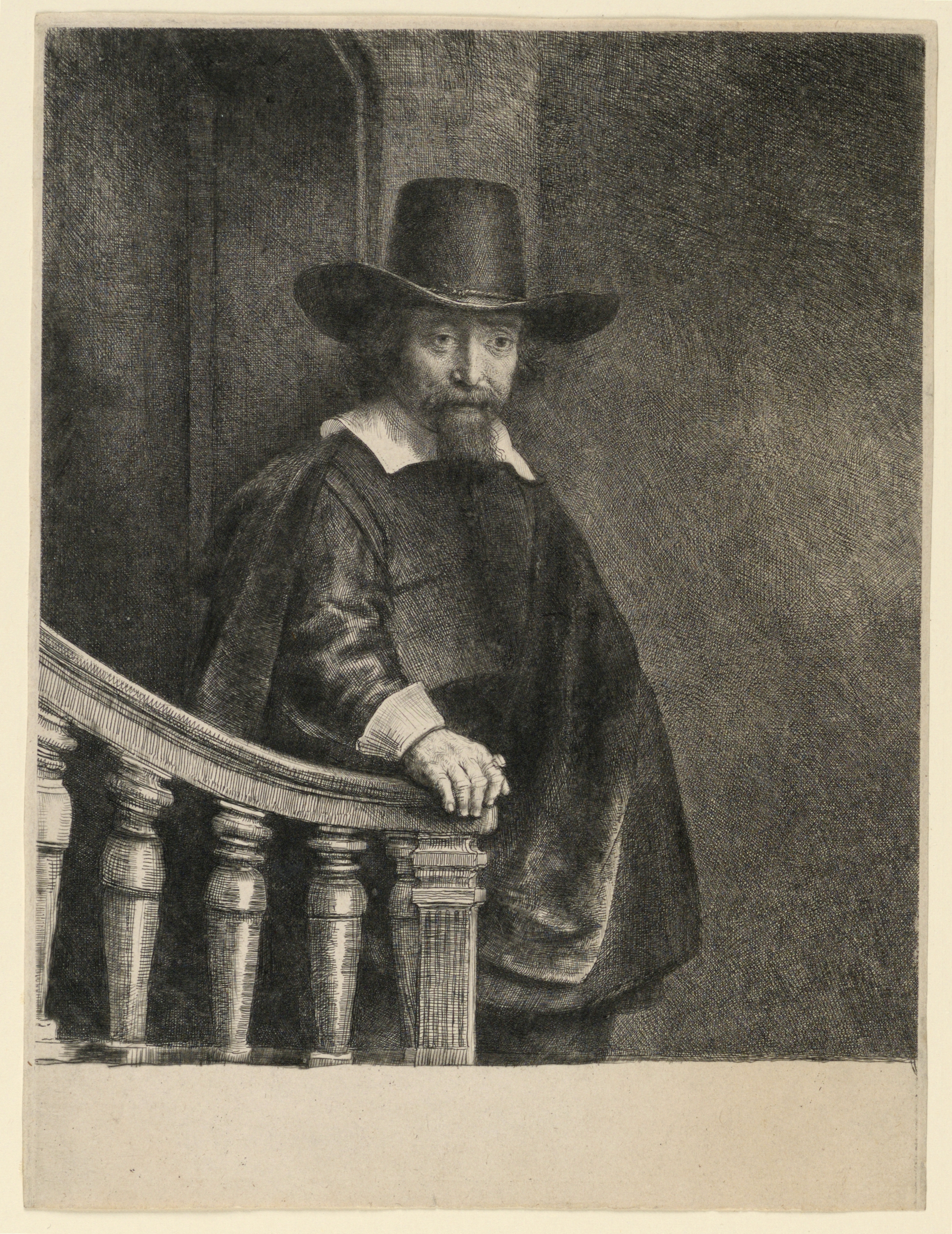
Three-quarter length figure of a man, standing, turned toward the right, the head in three-quarter view, looking to right. His right hand rests on the banister. He wears a cloak and broad-rimmed hat. Date: 1647. Medium: Etching on paper. Located in the Smithsonian Design Museum.
A Jewish Woman of Algiers

Print made by Eugène Delacroix (French, 1798 – 1863). Date: 1833. Medium: Etching on paper. Located in the Smithsonian Design Museum.
The Father of a Jewish Bride


Print made by Georg Friedrich Schmidt. An old bearded man in frontal view, slightly turned to right. Inscribed, lower left: “Rembrandt pinx 1641”; lower center: “Le Pere de la fiancée reglant sa dot, d’aprés le tableau original de Rembrandt tiré du Cabinet e Monsieur le Comte de Kameke”; lower right: “G. F. Schmidt fec. acqua – for. 1770.” Date: 1770. Medium: Etching on paper. Located in the Smithsonian Design Museum.
Siberia: A Jewish Massacre
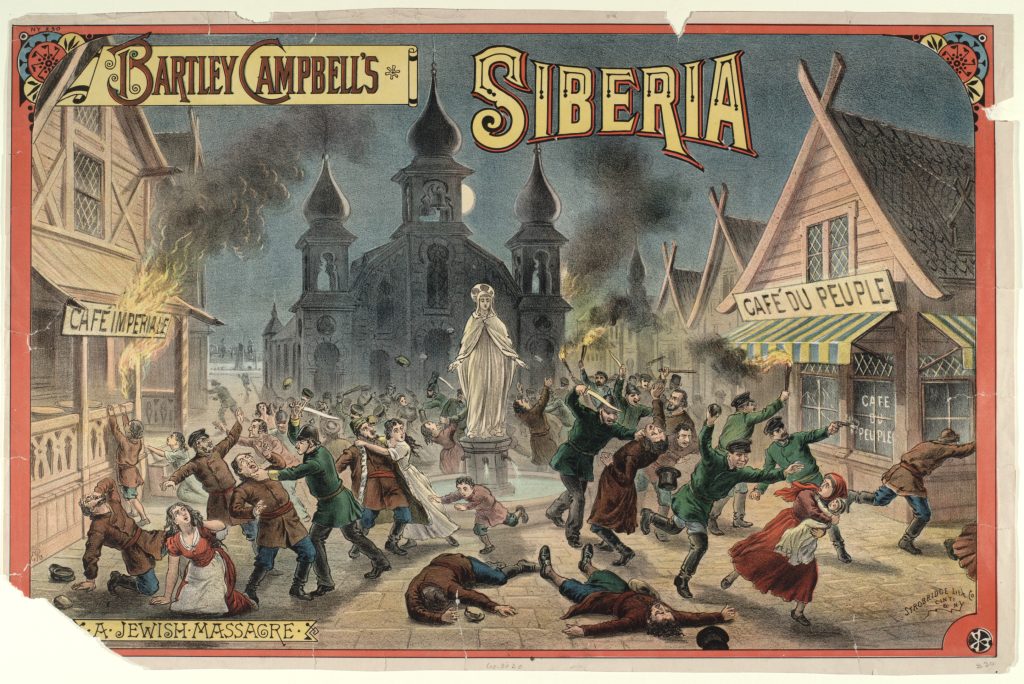
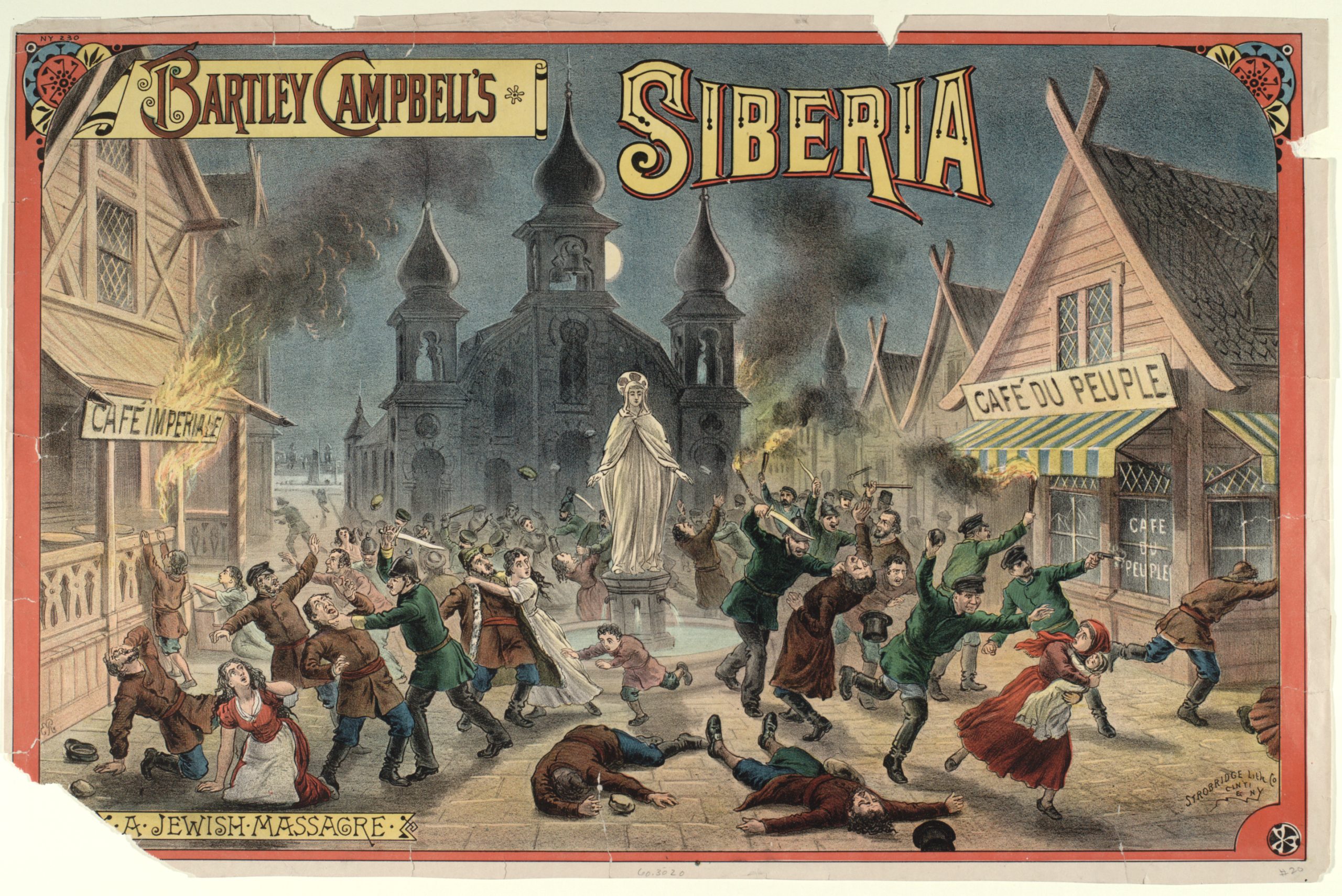
This colored print depicts a town square where soldiers with swords are attacking men, women, and children. Several people are on the ground, dead or injured. At the center of the print is a fountain with a statue of the Virgin Mary. A building emitting smoke and fire with the sign “Café Imperiale” stands on the left side of the square, and on the right another building carries the sign “Café du Peuple.” In the lower left-hand corner are the words “A Jewish Massacre,” indicating this is depicting a scene from the wave of anti-Jewish riots or pograms that swept through Russia during the 1880’s and resulted in loss of life as well as emigration to other countries. A Russian Orthodox church with onion domes appears in the background. The drama Siberiafeatured many prominent actors of the day and toured in England, Australia, and New Zealand.
Bartley T. Campbell (1843-1888), was a journalist, novelist, poet, dramatist, and theatrical manager. He was born to Irish immigrant parents in Pittsburgh, Pennsylvania, and began his writing career at age fifteen as a reporter for the Pittsburgh Post. He also worked for newspapers in Louisville, Kentucky, and Cincinnati, Ohio, and founded the Southern Monthly Magazine in New Orleans, Louisiana. After the success of his first melodrama, Through Fire, in 1871, Campbell gave up journalism for playwrighting and experimented with everything from comedies to domestic dramas to military sagas. Several of his works, including The White Slave, focused on racial themes and the plight of mixed-race characters. After an 1876 trip to London, Bartley Campbell began to write the western dramas for which he became especially famous, including The Vigilantes, or, The Heart of the Sierras. He has been described as America’s “first fully professional dramatist” (The Oxford Companion to American Theatre),and he also produced and directed plays. Later in life Bartley Campbell suffered from financial and mental problems and died at the State Hospital for the Insane in Middletown, New York. The Galley Slave, became a 1915 film starring Theda Bara.
This chromolithograph was produced by Strobridge Lithographing Company. The Strobridge firm was founded in Cincinnati, Ohio ca 1847 by lithographer Elijah J. Middleton (cited in some sources as Elijah C. Middleton). Middleton was known as one of the pioneers of chromolithography in the United States. By 1854 another lithographer, W. R. Wallace, along with the bookseller Hines Strobridge (1823-1909) had joined the firm as partners. After the Civil War, Strobridge acquired sole ownership of the company and renamed it after himself. Strobridge and Company became especially well known for circus, theater, and movie posters. After leaving the company, Elijah Middleton established a reputation as a portrait publisher, producing prints of George and Martha Washington, Daniel Webster, and other American historical figures. Date: Unknown. Medium: Paper, ink. Currently not on display.
Jewish Welfare Board Third Army AEF Postcard

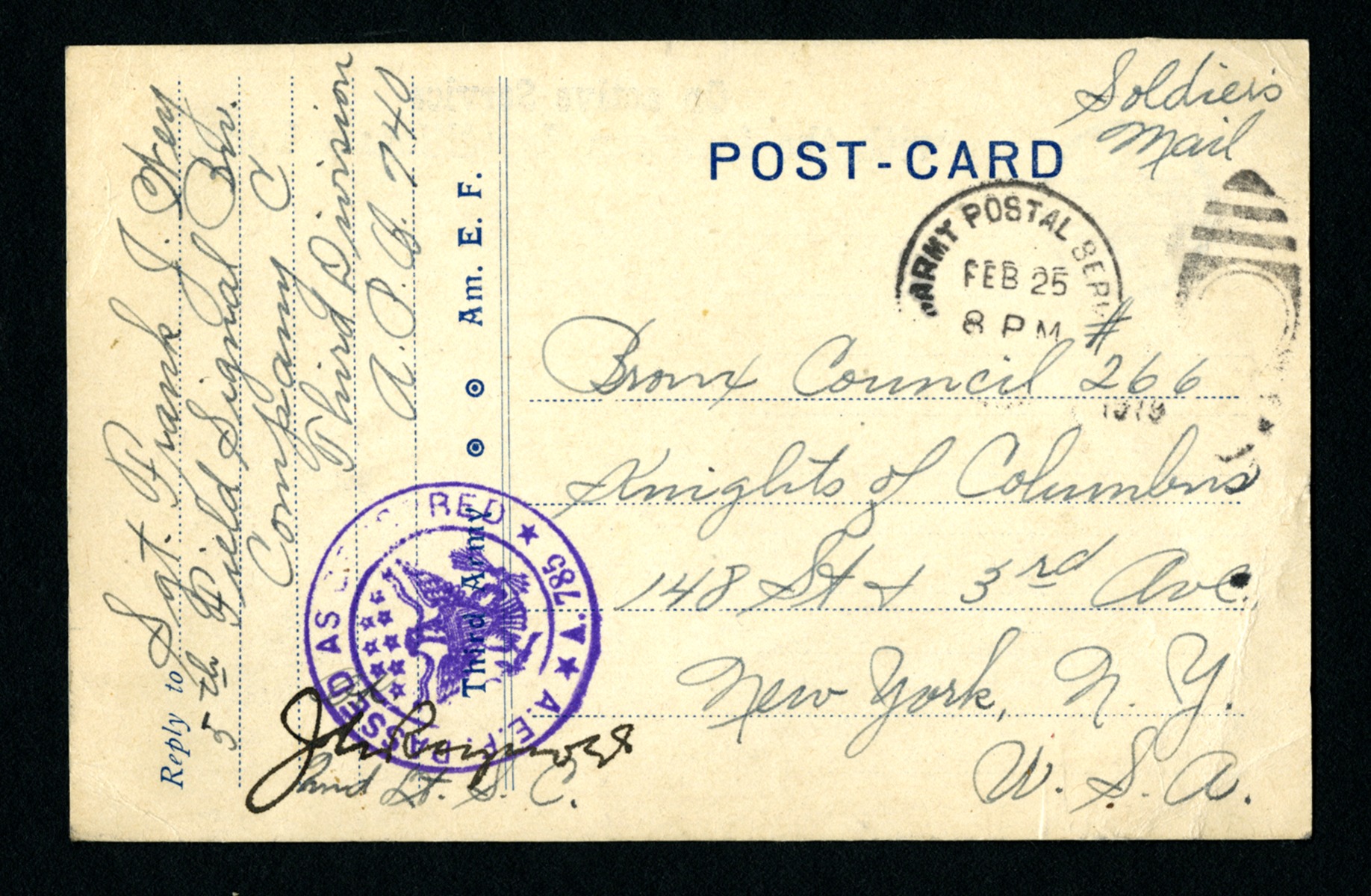
Postcard distributed by the Jewish Welfare Board to AEF members. World War I. Front has. The opposite side has handwritten message by Sergeant Frank J. Wey. Addressed to Bronx Council #266 Knights of Columbus, New York, New York. Franked soldier’s mail. Postmarked Army Postal Service, February 25, 1919. Censor mark with signature.
Message reads: Andernach A[m Rhine] Germany / February 23, 1919 / Dear Bro. Knights, Just a line from the Rhine to say “Hello” to you all. I see by the Council News that the communion breakfast is scheduled for May 30th. I won’t be able to attend this year as I will not be home until probably next January. Regards to all. Fraternally, Sergeant Frank J. Wey. Date: February 23, 1919. Medium: Paper, ink. Located in the Postal Museum.
Camilla’s Purse- An Interactive Exhibit
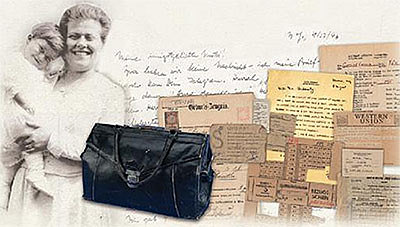
Holocaust survivor Camilla Gottlieb’s ordinary life in Vienna was upended by World War II into crisis, imprisonment, and ultimately a new life in the United States. Her purse, discovered by her family after her death in 1964, contained letters and papers that trace her trials and triumphs. These documents reveal a compelling story of captivity in the Theresienstadt concentration camp to eventual reunion with her daughter in New York. On view are the purse; her 1884 birth certificate; the suitcase, with her identification tag, that she carried during her journey to America; and various personal items collected from her time in the camp through her new life in America.
Jewish Welfare Board Uniform (Female)
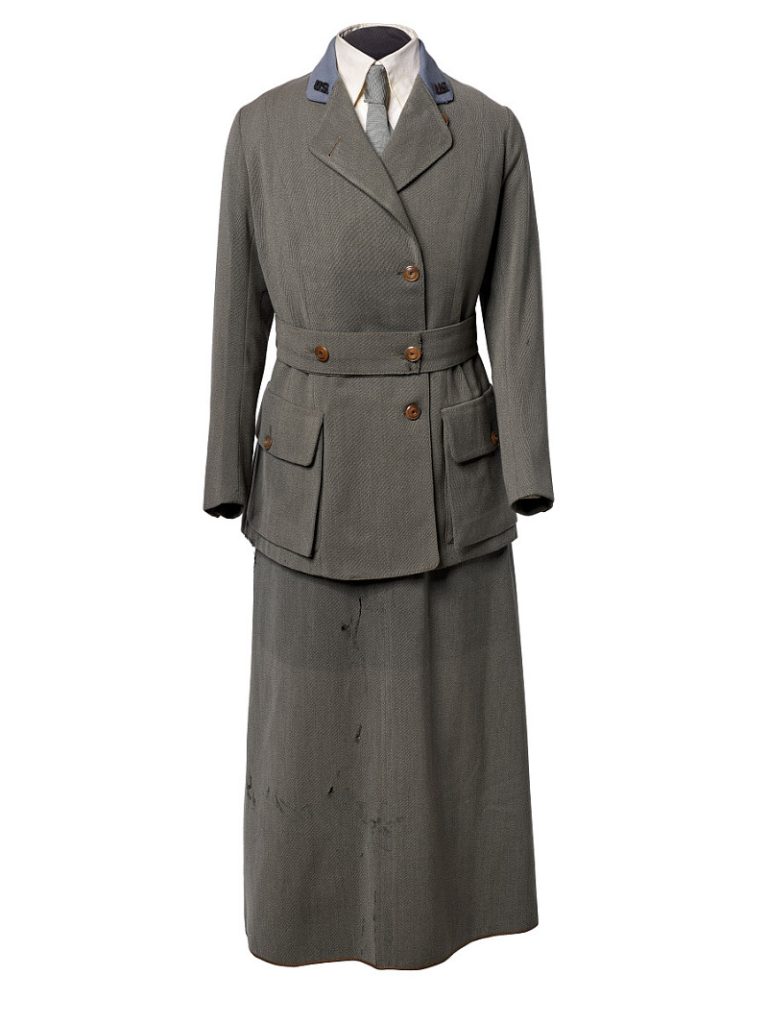
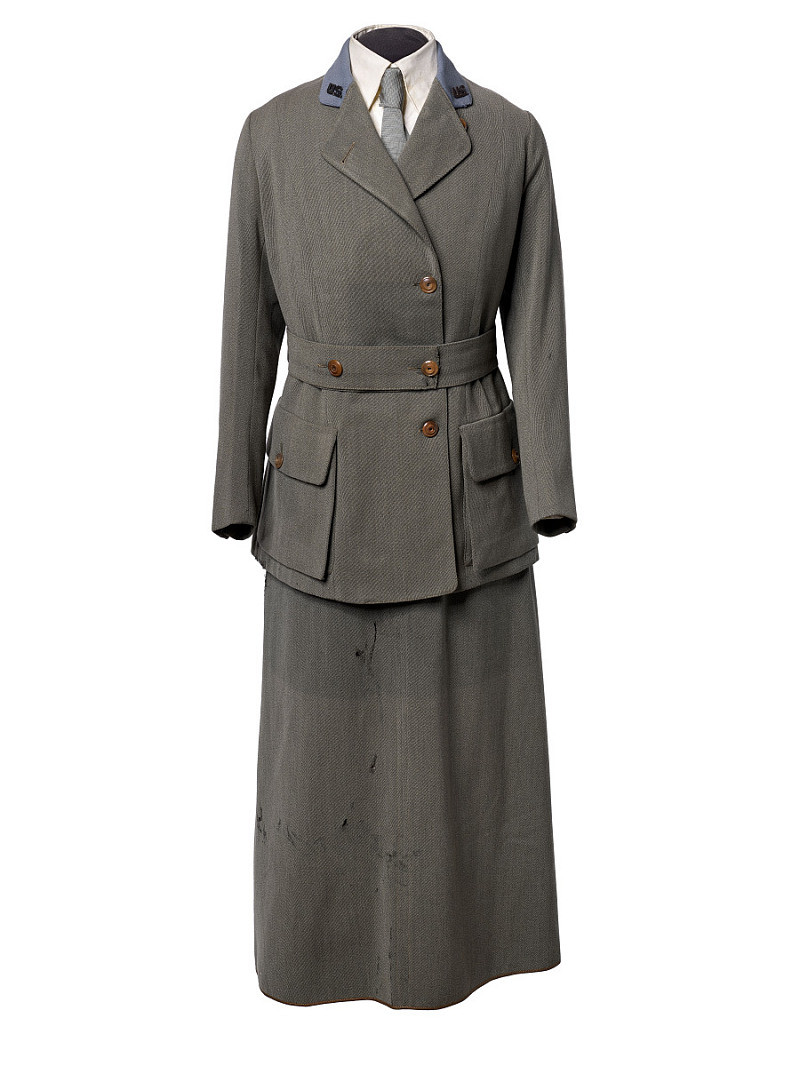
Women’s Jewish Welfare Board (JWB) uniform from World War I, consisting of hat, coat, shirtwaist, tie, skirt, and insignia. Coat and skirt are olive green wool gabardine, shirt is white dimity, hat is blue cotton, and tie is blue silk. Metal “U.S.” insignia on coat lapel and cloth “J.W.B.” patch with Star of David background on shouler and hat. Donated by the Jewish Welfare Board through The National Society of the Colonial Dames of America.
The Jewish Welfare Board (JWB) was organized shortly after America’s entry into World War I, consolidating religious groups in the Jewish community to become an official agency to work with the War Department through its Commission on Training Camp Activities. It was modeled after the Young Men’s Christian Association (YMCA) and the Knights of Columbus, and other organizations that in World War I adapted military-like uniforms for women and men volunteers. The JWB built buildings and stocked libraries on army installations and distributed books, articles, Bibles, and prayer books supplied through its affiliation with the Jewish Publication Society. It established community branches in the “second line of defense,” by supporting Jewish workers in the shipyards, arsenals, and other military plants and factories, as well as hospitals and universities where the government had taken over under military regulations. Following the Armistice, under direction of the Navy Department, the JWB transferred its peacetime work to veteran’s hospitals and enlarged Jewish community centers. Date: 1914-1918. Medium: Shirt. On display at National Museum of American History.
Jewish Welfare Board
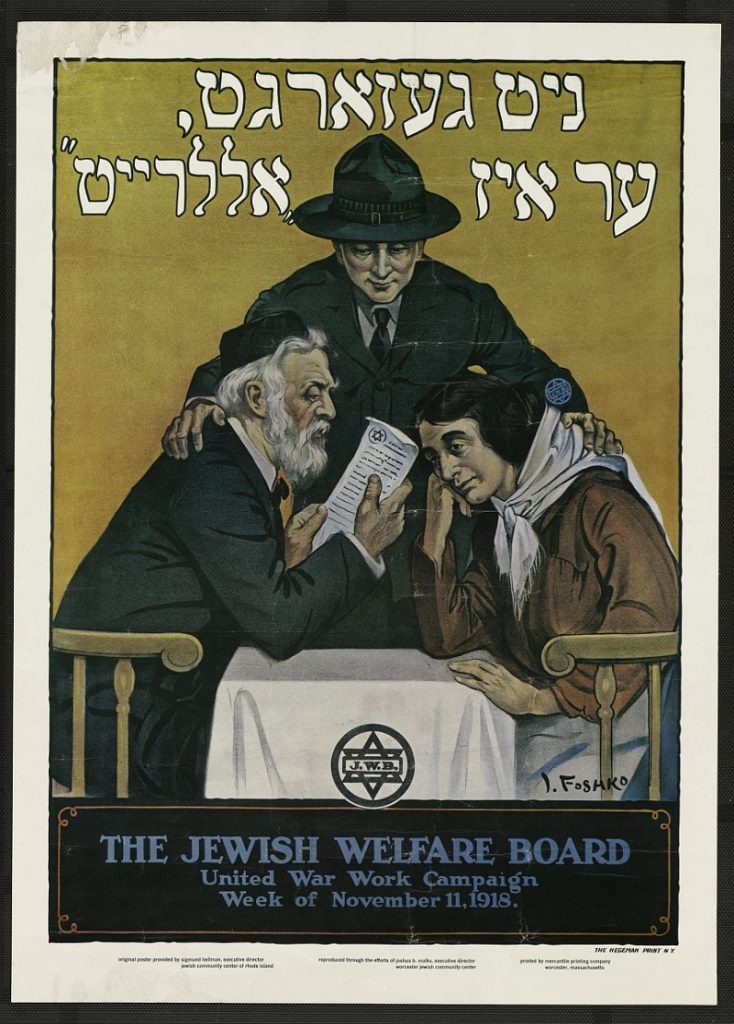
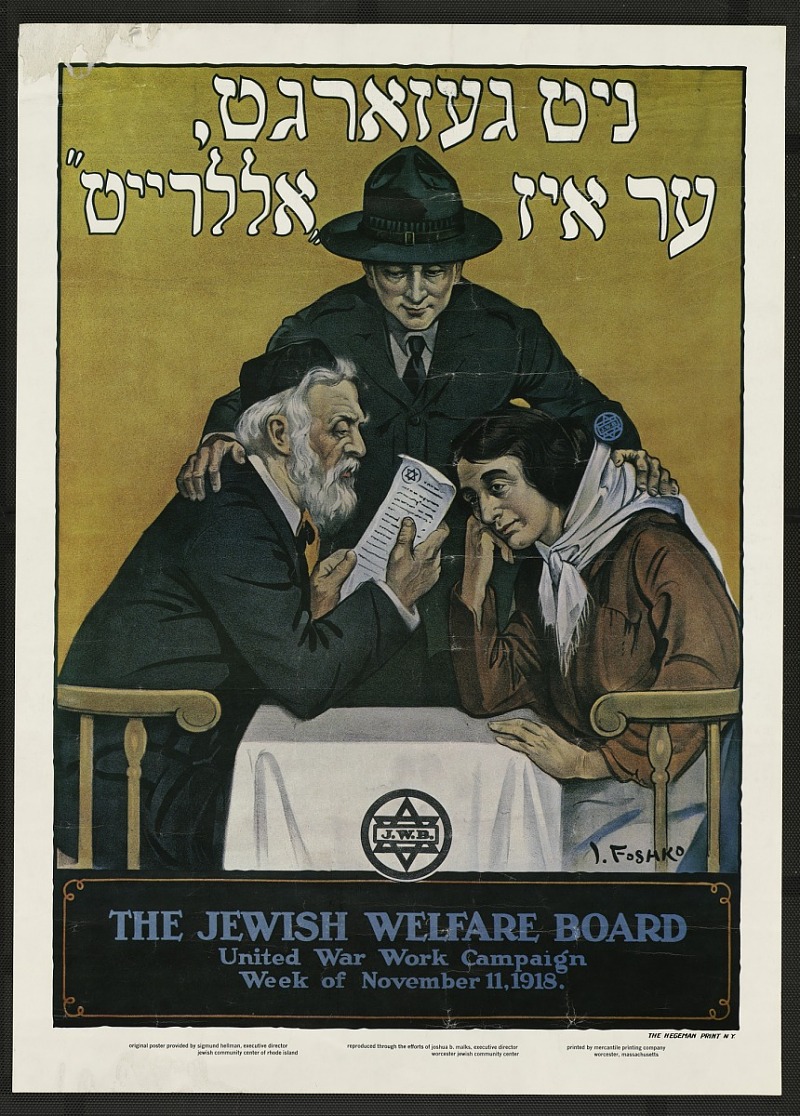
Date: 1917-1918. Medium: Poster. Not currently on display.
Jewish Market
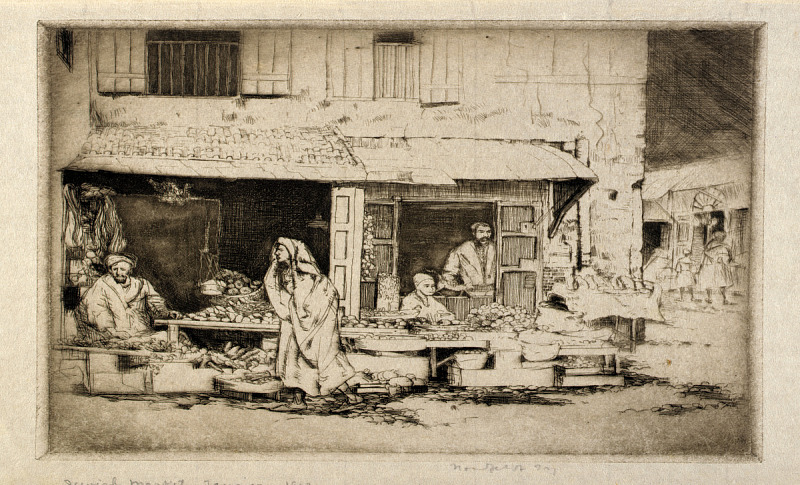
By B. J. O. Nordfeldt, born Tullstorp, Sweden 1878-died Henderson, TX 1955. Date: 1909. Medium: Print. On display in the American Art Museum.